


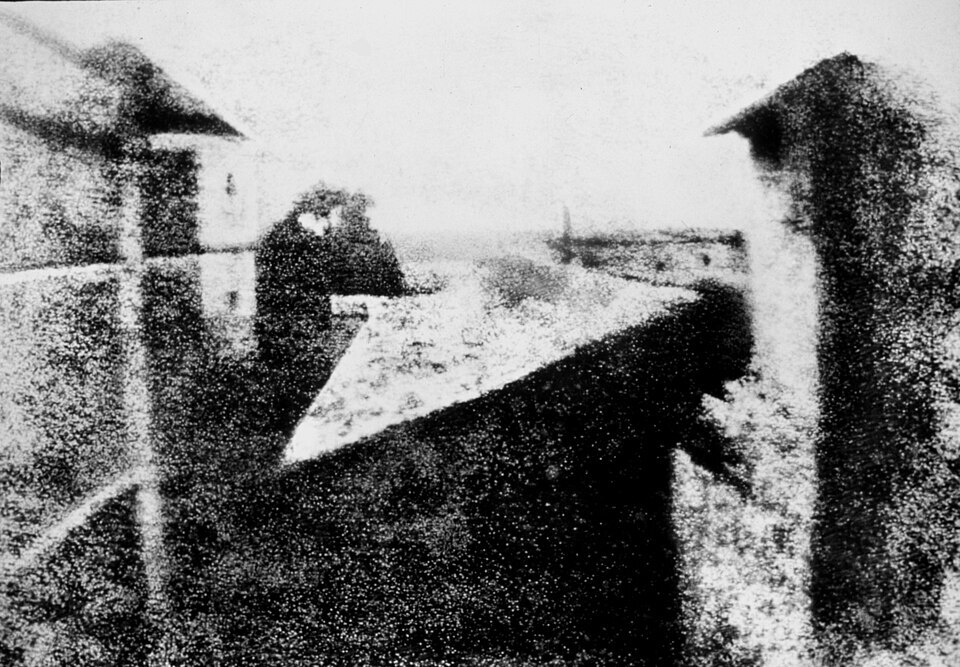
View from the Window at Le Gras

Endless classics at just $5
View from the Window at Le Gras
26 May 2026
View from the Window at Le Gras
Widely recognized as the oldest surviving camera photograph in history, View from the Window at Le Gras (La cour du domaine du Gras) was captured by French inventor Joseph Nicéphore Niépce in either 1826 or 1827.
The original image was created using a process Niépce called heliography (sun writing). He coated a polished pewter plate with bitumen of Judea—a naturally occurring, light-sensitive asphalt—and exposed it inside a camera obscura pointed out of his workroom window at the Niépce family estate in Saint-Loup-de-Varennes, France. Because the exposure required an estimated 8 hours to several days, the sun lit the buildings on opposite sides of the frame simultaneously.
Visual Description of the Enhanced Version
The image shown here is the iconic 1952 enhanced photographic reproduction created by photo historians Helmut and Alison Gernsheim in collaboration with the Eastman Kodak research laboratory. Because the original pewter plate is highly reflective and difficult to see with the naked eye, this high-contrast black-and-white variant was produced to clearly define the architectural silhouettes.
– Left Side: Features the distinct profile of a two-story wing of the Niépce family homestead, historically identified as the pigeon house.
– Center: Shows the sloped, angled roof of an outbuilding. In the distant background, a pear tree is faintly visible against a stark, overexposed sky.
– Right Side: Depicts the sharp vertical edge of the estate’s adjoining barn.
– Texture & Composition: The enhancement introduces a distinct granular, pointillist texture. The stark contrast eliminates mid-tones, turning the shadows into deep black shapes and the sunlit surfaces into bright white blocks, emphasizing the geometric layout of the early 19th-century French estate.
The original unenhanced pewter plate resides permanently in the Helmut Gernsheim Collection at the Harry Ransom Center at the University of Texas at Austin. It is kept inside a specialized, helium-filled steel suitcase to prevent oxidation and preserve the delicate bitumen coating for future generations.
You'll also like
-

Scarab
Antiquities3 years ago554 views
Read more -

Scarab of the King’s Mother Queen Nebuhetepti
Antiquities3 years ago623 views
Read more -

Relief Fragment Showing a Pile of Offerings and Part of An Offering List
Antiquities3 years ago573 views
Read more -

Falcon Protecting the King
Antiquities3 years ago477 views
Read more